
Texas Instruments
 Texas
Instruments (TI) pioneered the world revolution in Digital Signal Processing
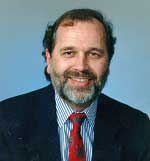
(DSP). Gene Frantz, Senior IT Fellow at TI was recently
in Bangalore. Amrita Ghosh of IT@TT met up with him for
an informal chat about the future of Technology. Here are some interesting
excerpts...
Texas
Instruments (TI) pioneered the world revolution in Digital Signal Processing
(DSP). Gene Frantz, Senior IT Fellow at TI was recently
in Bangalore. Amrita Ghosh of IT@TT met up with him for
an informal chat about the future of Technology. Here are some interesting
excerpts...
IT@TT: What are the key issues addressed in this fest?
GF: The most important thing that we do is give like-minded, DSP-literate and educated students, third parties and small companies working with us, an opportunity to get together, exchange ideas, find out how we're all the same, build relationships and just spend some time together. We're having some real good lectures at this year's fest.
IT@TT: You attended the DSP fest 2 years ago. Has the event developed?
GF: It has grown. When it started we had about 300 people. This year it seems like there are about 700 people. It's interesting how technology's grown too. We're all going to put in our inputs to ensure that it grows.
IT@TT: How has the technology's grown?
GF: It's gotten faster. It's grown to a higher form and naturally the cost has lowered. Now the emphasis in on understanding and power dissipation. There was a time when it was"Give me more performance." Ten years ago, people started saying, "enough performance. Give us lower cost, so that we can do new things." In the last couple of years power dissipation has become interesting and can be considered as a serious advantage or disadvantage to DSP.
IT@TT: How does it affect DSP?
GF: Let me turn that question around and answer. Technology's become real fast. I can now do things that I really couldn't have imagined before. It was expensive before, but now it's cost effective. Things that I desire are affordable and all because of power dissipation.
Now we look at three different areas: the central office, high performance imaging, and radical imaging that requires lots and lots of performance, but doesn't necessarily need to be portable or low cost. Then we have other products that need to be low power. For example, the cell phone. People are willing to pay another couple of hundred dollars, if the battery lasts 3-4 weeks. So when you consider such issues, you say that there's not enough performance.
If I, by reducing the power, can give you a month rather than a week, then I could also give you a week to reduce the weight by 50 percent, because I'll be using less battery. So lower power dissipation not only makes it portable in the sense that it goes longer on batteries, but it also makes it easier and unobtrusive enough for me to carry it around.
IT@TT: But how tiny can such a wearable computer be?
GF: It can be as small as just a square centimetre. It'll have more performance and more capability than you can envision right now. We're working with universities to replace a natural eyeball with an electronic one. And the initial results are very promising.
IT@TT: So is that TI's vision of DSP?
GF: That's one of the visions. If you really need to and want to uncover new business opportunities, you need to understand that increasing performance opens up new business opportunities. That'll also occur due to low cost and power dissipation. There are uniquely different businesses that you can create.
IT@TT: Where do you see this vision a few years down the line?
GF: What I visualize and hopefully I'll be able to implement it successfully is a technology I've been working at. It's called wearable computing. It's a pretty simple concept. There's a need in the industry to have a computer with me. That is it should be portable, I can have a certain degree of control over it and I can wear it, like this one (shows the one he's wearing). I may have IP software that's helping me read the displays. I may use the Speech Recognition to control it.
Just imagine me as a Miami ship inspector going around in my little boat, when storm breaks. I'd like to have both my hands free to document what's going on. I may even have a digital camera attached to my computer for taking snapshots. I may even have a wireless attached to it, so that I can transmit the entire record back together with my descriptions and pictures. So the concept comes in handy in various industrial sectors.
Within the next 5-10 years, virtually all our computers will be wearable. Just as I'm wearing a computer today that's essentially a palm pilot and I have to search for it, a day'd come when I'll be holding all the information at my elbow and won't have to reach beyond it.
IT@TT: So, it's basically convergence of technology?
GF: Convergence yes. I'm trying to converge on my computational elements, which is becoming more and more personal. If you take a brief history of the world of computers, first we had a main frame with thousands of users on one computer. Then we had many computers with tens of users. Then we went through PCs, which was one user, one computer. But, now look at Internet appliances and computational elements. We now have multiple computers for individuals.
The next step'll be more and more computers for one person. And it's all about customization and personalization. Now I'm wearing one computer on my body. In 4-5 years time, I'll be wearing 4-5 computers on my body.
IT@TT: But, how desirable will this be?
GF: In order to jump to that, let me go back to another technological breakthrough that occurred about 20 years ago. If I [then] had an answering machine and after calling my house, you were accosted with one, your probable reaction would be "How rude of him to have an answering machine! I wanted to talk to him and not to his stupid machine." I almost became an outcaste. Now if you call my house and in my absence, fail to find an answering machine, you'd think "How rude! I could've at least left a message." So, in 20 years what was repulsive technology has become acceptable and it's repulsive not to have it.
IT@TT: So, are we into the Information Age or still poised on the edge?
GF: We're into it and it'll work. It's not one of those surgically inserted things that wear out one day. But if you look at a hearing aid, then what we're trying to do is change a problem to a solution by helping you hear better. Even if I'm not in a quiet place, DSP technology will help to cut out the noise. So as you wear a hearing aid, you can very well wear computers.
If I can think of other medical utilities, I wish there was a way to monitor a patient's health in case of diabetes or asthma. If DSP can help to minister the required medication as and when required, it'd help to bring down medical bills. If you get to the age where you have constant heart problem, then you'd feel safer wearing something on your body that monitors your health. In case you feel an oncoming attack, you can call for medical help on the wireless.
My students came up with 5 different areas in which wearable computers will be useful - communications, entertainment, education, medical and environmental control. When we walked in here, we had to ask the air conditioner to be turned on. Why did we need that? The computer could've easily adjusted the temperature. My students think communications is going to be the winner. But I think its entertainment that's going to be the killer area.
IT@TT: That sounds OK for specifics. But, on a mass level wouldn't wearable computers would be breach of privacy?
GF: I like that one. Answering your questions is fun, because, you're asking the right questions.
Our privacy is invaded all the time. We lost that issue 20 years ago. You can't write a cheque or use your credit card without a hundred people being privy to your personal information that you wouldn't want to divulge.
If for some reason, somebody's trying to breach my privacy through the computer network, then I need to have at least one of my computers acting as a security agent, stopping you and preventing you from accessing my personal information. Because all of a sudden my computer and me become the same. So now the idea is that since they'll inevitably get all the information, how do I stall it? So if you want information from me you'll have to buy it. I'm not going to give the information to you. I can hand over my entire year's record to you on a floppy, so that you can leave me alone.
Interviewed By Amrita Ghosh
[email protected]
Other Articles
ChiefChat
| Mailbox
| NerdWord
| ProductPreview
| SiteScan
| Techtalk
| Tips&Tweaks
VirusWatch
| Webware