
 Indian
Talent
Indian
Talent
 Shiv
Nadar
Shiv
Nadar
The
Giant Killer
Shiv
Nadar, 53 years of age heads the US$ 1.2 billion HCL Group based at Delhi,
US.
Moving to Delhi from Tamil Nadu in 1968, Shiv Nadar worked as an engineer
with DCM Ltd. Keen on starting on his own he made six of his colleagues
to join him to launch a firm making office products like copiers. In 1976,
Mr. Nadar initiated HCL as a startup firm with the same visionary zeal
that today, symbolizes the rapidly growing $ 650 million Indian IT conglomerate
with offices spread across 33 locations in 14 countries. Into the vacuum
created by IBM quitting Indian HCL stepped in to supply computers and
by 1982, HCL came out with its first computer.
He transformed HCL corporation one of the top most firms making computers
and office equiment. Now over 80% of HCL's revenues are from computers
and office equipment.
While concentrating on growth at home, HCL has also been spreading its
reach overseas. Its Singapore subsidiary, Far East Computers, recently
achieved a breakthrough in imaging technology, which, among other applications,
enables computers to read handwritten tax returns.
In the U.S, a software subsidiary, HCL America, has reaped rich benefits
by taking advantage of global time zones. Every morning, the company's
Madras office receives software assignments from the U.S, just after work
stops there for the night. A team of Indian engineers, with salaries much
lower than those of their American counterparts, complete the jobs and
modem them back in the evening.
Far East and HCL America account for almost 20% of HCL Corp.'s annual
revenues. Once he makes up his mind about a project, he picks a team,
then leaves it alone to get on with the job. The February 1997 issue of
TIME magazine wrote: "The world has caught up with Nadar's vision of a
networked future, and the results are shaking up enterprises, economies
and government around the world". He attributes the Group's success to
teamwork and the entrepreneurial spirit, which together have enabled it
to handle rapid change in environments and technologies, and to transform
threats into opportunities and market differentiators.
Fundamental to the process has been the development of new paradigms for
the unprecedented situations into which the Group ventures. Developed
from first principles, these include guidelines for organization restructuring,
market creation, technology leveraging and business upscaling. Mr. Nadar
personally heads the think-tanks which address the conceptual bases of
the Group.
Dataquest IT man of the year for 1995, quoted by Time magazine for his
vision of a networked future, and placed amongst 'the electronic elite'
by Geoffrey James in his book "The Giant Killers", is India's most effective
entrepreneur - Mr. Shiv Nadar.
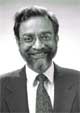 Suhas
Patil
Suhas
Patil
A
Visionary
Patil was born in Jamshedpur (Bihar) in 1944 and grew up
with a strong interest in technology and science. His father repaired radios
as a part-time job, and the young Patil worked with Mechano sets and the
like and learned English so that he may read Popular Science magazine. He
once burned his fingers while attempting to set up a Bunsen burner in his
backyard. Such was a passion he displayed for science. Patil also acquired
a passion for photography from his father.
He went to the Indian Institute of Technology, Kharagpur where he earned
a B. Tech (Honors) degree in electrical engineering. In 1995, the IIT conferred
an honorary doctorate degree on Patil. Last year, Patil donated $1.5 million
to MIT�s Laboratory of Computer Science.
For years he was an assistant professor of Electrical Engineering
at the Massachusetts Institute of Technology (MIT) and later associate professor
of computer science at the University of Utah. He entered academia soon
after earning his Masters and doctorate in electrical engineering at MIT.
But between the two university jobs, he made a fleeting return to India
in the hope of serving industry there. In the early 1970s, India was not
only way behind in technology but also its companies conducted no research
at all. The companies that wanted to hire Patil apparently wanted him to
clone existing models, not undertake original work or research. Disenchanted,
he came back to join the University of Utah, where he expected to continue
research.
After five years there, Patil�s research reached a stage where �either somebody
had to adopt it and take it further, and that�s what I was seeking,� he
once told an interviewer. That somebody happened to be General Instrument
Corporation, which had also funded some of his earlier research. With the
funding, Patil completed work on a software that automated VLSI (Very Large
Scale Integration) design.
Although in
1981 Patil started Patil Systems, 3 years later he joined hands with Mike
Hackworth and found Cirrus Logic, a Semiconductor firm in the Silicon Valley.
The book 'The Making of Silicon Valley: A 100-Year Renaissance', counted
Cirrus Logic among the companies that shaped the valley.
Patil has also stepped aside from the management of the company, and holds
the position of chairman emeritus. But he is now an active �angel� investor
in the valley and a mentor to many entrepreneurs through the non-profit
organization The Indus Entrepreneurs (TiE). Known as a visionary, Patil
is said to be flooded with business plans from young entrepreneurs.
A national magazine once said Patil only accepted business plans in the
form of 20-minute videocassettes and set up meetings with prospective entrepreneurs
only if he likes the video. Patil�s portfolio of companies includes RightWorks
and NavinMail, in which his wife Jayshree is a senior executive.
Vanu
Bose
Inventing- his pastime
He
received a B.S. in Electrical Engineering and a B.S. in Mathematics from
MIT in 1988, and an M.S. in Electrical Engineering from MIT in 1994. Vanu
Bose is the son of Dr Amar Gopal Bose, scientist and founder of Bose Corporation.
Vanu Bose has a Ph.D in Electrical Engineering and Computer Science and
is the joint inventor Software Radio. He is also the founder of Vanu, Inc.
a Software Radio startup company. Vanu spent two years employed as a Bio-medical
engineer for Project Orbis, an international NGO which fights blindness
through education. Following two years in the field, Vanu designed and implemented
the computer and satellite communication systems for Project Orbis' new
DC-10 hospital aircraft.
Since then Vanu has done consulting work in wireless communications. Vanu,
Inc. works on commercializing the software radio technology that was the
subject of Vanu's dissertation. He decided to start the company because
several of his friends shared his view on the exciting commercial possibilities
of the technology. There were four founders, Mike Ismert who got his M.S.
at MIT and worked on the SpectrumWare software radio project at MIT for
many years, Jonathan Santos who received his M.Eng. degree from MIT and
was also involved in the SpectrumWare project. Andrew Beard with a background
in Business law, and himself.
In the long term, Software Radio will simplfy people's lives and bring new
technology to market faster. It will enable one single device to fill all
of your communications needs: cellular telephone, cordless phone, pager,
radio, garage door opener, baby monitor...anything wireless.
New technologies, such as new digital communications standards will simply
be software downloads to an existing device, instead of the expensive hardware
upgrades of today, enabling new technology to reach the consumer faster
and cheaper.
 Vinod
Dham
Vinod
Dham
Chipping
in..
Vinod Dham known as the Father of Pentium is the CEO of Silicon Spice Inc.
In 1975, the Indian born Vinod Dham arrived in the U.S. on an engineering
scholarship at the University of Cincinnati, with less than $10 in his pocket.
His first job at NCR was in 1977, working for the memory design group. Impressed
with his paper on reprogrammable memory, Intel took him on.
As the leader of Intel's Pentium team in the early 1990s he earned the title,
"Father of the Pentium". Later he quit to join a start up, Nexgen. Three
years later, AMD's K6 chip, based on the Nexgen technology, gave nightmares
to the people at Intel.
Dham was invaluable to the world of chip design. He left AMD to work for
another big company- Silicon Spice, a Mountain View, California startup
(started in 1997) focusing on communications chips. "Silicon Spice is developing
a radically new communications technology," Dham said in a statement. "I
chose to join Silicon Spice due to the potential it offers in the emerging
communication-centric information industry."
Vinod Dham, a man who has made a career out of microprocessors, is not interested
in microprocessors, which is an integral part of personal computers. He
is now interested in communications processors. "With demand for communications-related
chips growing at 20% per annum, the microprocessor business has become less
interesting" says Dham.
In his opinion, the Internet is the mother of all killer applications, which
could utilize most computing power if there were no bandwidth bottleneck.
Anyone, who can help unclog this bottleneck, holds the key to a multibillion-dollar
bounty. "The personal computer was designed for computing, and not for communication.
The microprocessor has gone beyond its use," he says. In other words, the
hardware is far ahead of the current computing requirements. So is Silicon
Spice competing with Intel? "No we are not competing with Intel, instead
we are complementing Intel by solving the bandwidth bottleneck," says Dham.
"My heart really was to go back and run a company on my own," Dham said.
"For me personally, it's very intellectually challenging to be here. You
don't get a chance like this when you're inside Intel or AMD or Cyrix. The
job descriptions get sliced so thin that at the end of the day, you wonder
what your contribution was."
According to the recent press release, Broadcom is to acquire Silicon Spice,
Inc. adding Vinod Dham to the management team in the process. Broadcom is
the leading provider of highly integrated silicon solutions that enable
broadband digital transmission of voice, video and data to and throughout
the home and within the business enterprise.
 Vinod
Khosla
Vinod
Khosla
The Rising Sun
Mr. Vinod khosla was the founder of Sun Microsytems.
Khosla, grew up in Delhi and completed his B. Tech at IIT Delhi. He attempted
to start a company in India, a dream he had carried with him since the
age of 15. He was frustrated by the experience and decided to pursue M.S.
in Biomedical Sciences at Carnegie Mellon. He also obtained an MBA from
Stanford University in 1979.
He wanted to work for companies that were started after 1976 and that
had less than a hundred employees. Unfortunately, he couldn't find a job
which met the criteria and so he turned to the entrepreneur mode. With
business partners from Stanford, he started Daisy Systems, a computer-aided
engineering and Design company, which failed as the economics of the market
went against it.
He looked for other opportunities and met up with
Andreas Bechtolshiem, who had designed a workstation at the Stanford University
Network. He was licensing it to companies at $10,000 and Khosla convinced
him to start a company to manufacture them. He pulled in two more of his
friends and founded Sun Microsystems.
He was an unpopular manager and did not play a part
in building the company to its present size as he was eased out of his
position as CEO in 1986.
Soon he joined Kleiner Perkins, the firm that funded
Sun as a general partner. As
a partner at the venture
firm of Kleiner Perkins Caufield and Byers, Khosla is also in the business
of fashioning companies and technologies.
He started off Cerent, one of the hottest startups,
later acquired by Cisco for $ 6.9 billion. He assisted Pradeep Sidhu in
the making of Juniper networks.
Full of energy, Khosla, at 44, does more than what a 20 year old invidual
normally does.
