
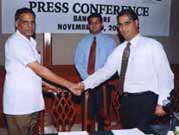
Professor S. Sadagopan and Kishore Rao IIIT-B and PTC
 Recently
PTC India (Parametric Technology) announced a partnership with the Indian
Institute of Information Technology (IIIT), Bangalore, to assist in the
development of a CAD/CAM laboratory. Amrita Ghosh of IT@TT met up with
Kishore Rao, Managing Director, PTC India and Dr S Sadagopan, Director,
IIIT Bangalore. Here are excerpts.
Recently
PTC India (Parametric Technology) announced a partnership with the Indian
Institute of Information Technology (IIIT), Bangalore, to assist in the
development of a CAD/CAM laboratory. Amrita Ghosh of IT@TT met up with
Kishore Rao, Managing Director, PTC India and Dr S Sadagopan, Director,
IIIT Bangalore. Here are excerpts.
IT@TT: When did you conceive of this idea of a MoU between IIIT-B and PTC?
SS: It was almost a year back. We were looking at tie-ups with various industrial segments. PTC being the world leader was a natural choice. So it was last October-November that we thought about this.
IT@TT: What's the focus of this tie-up? How do you think PTC will benefit from this association?
SS: One of the focus areas of IIIT-B is its CAD/CAM labs. We call it a focus lab.
KR: I believe that those students who'll imbibe this learning will feed the requirements of the industry. That's a short-term benefit. Secondly, these students are the advocates in their respective careers and we definitely want to help them in whatever small measure. Plus we'd like to be a part of B2B/B2C solutions.
IT@TT: I believe the partnership actively started some time back and this is just an official announcement. So Professor, what's been the response from students?
SS: There's something called exploration. You can't expect a large company like PTC to come to an unknown institution like IIIT that's a couple of months old and say that we'll sign up. Let's be reasonable. But because they thought this to be important, they were also being calculative. They wouldn't want to give out their brand image to an institution that is yet to prove. But there's a certain amount of personal credibility that we all carry. Using my connections, we were able to start this off. The actual realization of this project will happen only next semester. Because, by the time everything could be arranged, we were well into the second semester. However, whatever initial amount of exposure students had, they're excited. But excitement alone cannot sustain this venture.
IT@TT: How are you going to go about implementing this? Are you going to give training to the staff?
KR: Yes. The first step's going to be training for the staff. Second step will be regular interaction. I propose to go and tell the students the expectations from the industry side. This kind of interaction with the students will only make our venture more meaningful. And the fact that we're in Bangalore helps.
IT@TT: So what do PTC and IIIT stand to gain from this tie-up individually?
SS: There are 2 angles to this, short-term and long-term. Short-term gain I feel is that we have access to the software. I can meet all my demands. The long-term gain is that we get to work with a world leader like PTC and this has given us access to not just their products, but also their technologies. Plus we also get our students to work in their development centres. I could've always approached their development centres. They'd have looked at me as just another institution. Now they'll look at me as their partner institution. So it's not just a question of strength in numbers, it's also a question of strength of quality.
KR: The level of partnership with premier institutions like IIT and IIIT-B is at a different level. There are engineering colleges who buy the software and make it a part of their curriculum. So a lot depends on the level of partnership. Since we are headquartered out of Bangalore, the level of interaction is expected to be much higher and we consider this to be a premier partnership.
IT@TT: So it's 'Gyanam Uttamam' all the way (smiles).
KR: Yes, that kind of sums it all up. As a company and as an institute, we have our own objectives and generating revenues is just part of the whole. If you have a lot of people talking about the products then revenue comes in indirectly, but naturally. If your customers are happy and satisfied then you don't need to count your revenue. It's a distorted approach to always calculate how much revenue I'll generate by implementing a product. American companies are considered to be very money-minded. So my saying this may come as a surprise.
SS: The model of IIIT-B is unique. We're not a computer science institute. We're an IT institute. What other places pursue individually, we pursue collectively. That gives us synergy. Our institute is meant to compliment, not compete with existing institutions like IIT. That's our focus.
IT@TT: Where do you see this partnership a few years from now?
SS: It'll be like C-commerce, i.e. collaborative commerce. Right from design to manufacturing, to production, to servicing and hosting, everything is done. PTC is very strong in this. What basically happens is that you consider these things separately. With more and more things happening electronically, it is possible to bring it together. Even private information at times has to freely float between all the departments. So it's important to collaborate at a component level.
IT@TT: Everybody keeps talking about new products and designs, but how much of a reality is this? Do you think India is moving on from body shopping to serious product development?
SS: One of the mistakes that people commit is that they get overly obsessed with one or two examples. What people don't realize is that worldwide, product revenue in software is just 30 percent. The rest of the 70 percent come from consulting. We take on lots of consultation. Similarly, there are plenty of products that you don't see. But they exist nevertheless. People need to realize that the industry is much wider. Don't ever think that body shopping will go away.
In a country like India, IT has a role to play. For billions of people you need millions of jobs. For an ordinary graduate, who can't afford further education, writing simple pieces of code offers a decent means of livelihood. So as long as India benefits from it, we should be happy. So let us not look down upon body shopping. I believe that we're already moving beyond this. There is something called digital services from Novell, where the product comes entirely out of the Bangalore office. Some key components of SAP come out of the SAP lab in Bangalore. Lots of technologies are already happening and the list is quite big.
Interviewed
By Amrita Ghosh
[email protected]